 |
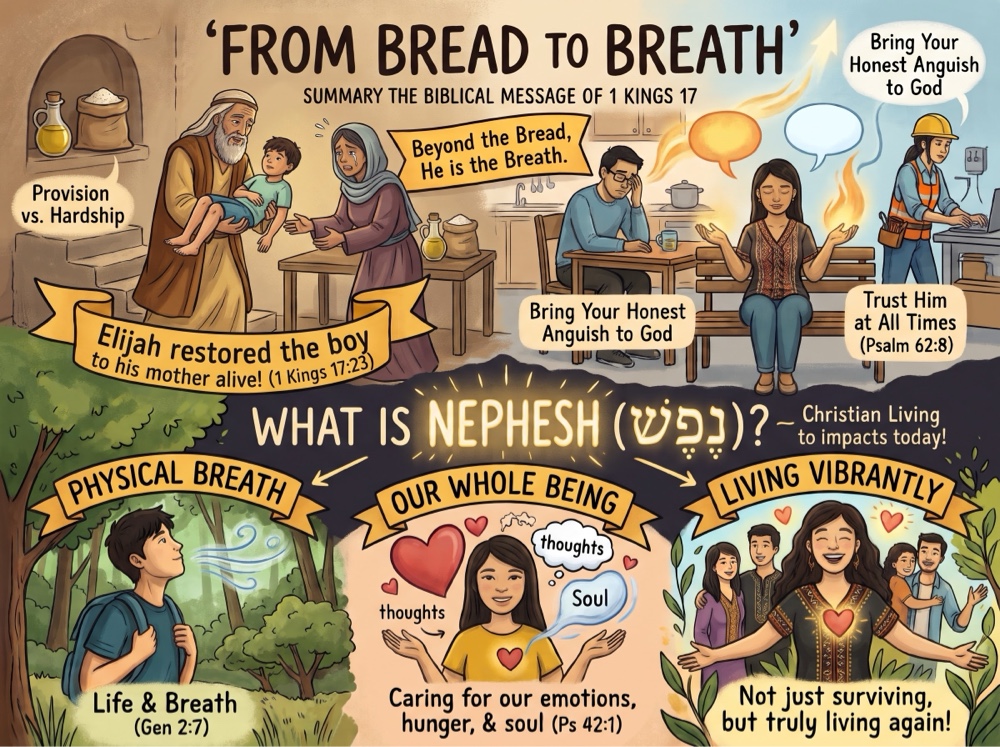
From Bread to Breath
In 1 Kings 17:17-24, the widow of Zarephath witnesses a staggering miracle: God provides an unending supply of flour and oil to keep her family alive during a severe drought. Yet, shortly after receiving this supernatural provision, her son falls ill and stops breathing. Her immediate reaction reveals human nature in its rawest form—she looks inward and asks if her own sin brought this tragedy upon her.
We often make the same assumption, believing that being in God's will shields us from hardship, or that sudden suffering is a direct penalty for past mistakes. But physical and material provision does not exempt us from life’s trials. As Elijah demonstrates, God does not ask us to hide our confusion or put on a brave face. Like David in Psalm 13 and Psalm 62:8, Elijah brings honest anguish to God, crying out and pouring his heart out to the One who holds all life. James reminds us that "Elijah was a human being, even as we are" (James 5:17). He had no super-human status; he simply trusted a God who listens. When God raised the child, the widow’s confusion was transformed into confidence, declaring, "Now I know that you are a man of God and that the word of the Lord from your mouth is the truth."
Word Study: Nephesh
In verse 22, the scripture records that the Lord heard Elijah's cry, and "the soul (nephesh) of the child came into him again, and he revived."
While nephesh is frequently translated as "soul" in traditional English Bibles, its original Hebrew usage is far richer, more concrete, and deeply grounded in human existence.
NEPHESH
Breath / Throat -> Physical Essence
Whole Person -> Desires & Emotions
Living Being -> Whole-Life Vitality
+-------------------------------------------+
1. The Physical Root: Breath and Throat
At its core, nephesh refers to the physical organ of breathing—the throat or neck—and the physical breath of life.
- Genesis 2:7: God breathed into Adam’s nostrils the breath of life, and man became a living nephesh (living being/soul).
- Isaiah 5:14 & Jonah 2:5: Used to describe the physical throat or waters engulfing the neck.
2. The Entire Person and Appetite
In Hebrew thought, a human does not merely have a soul; a human is a soul. Nephesh encompasses the entire embodied person—their physical cravings, emotional longings, and deep desires.
- Psalm 42:1: "As the deer pants for streams of water, so my soul (nephesh) pants for you, my God." Here, physical thirst and spiritual longing merge under the same word.
- Proverbs 16:26: Refers to the worker’s appetite (nephesh) driving them to labor.
3. Life Itself
Nephesh is the vital life-force that animates a creature. When breath departs, the nephesh leaves; when breath returns, the nephesh is restored.
- Leviticus 17:11: "For the life (nephesh) of a creature is in the blood..."
- Genesis 35:18: Describing Rachel's death as her nephesh was departing.
Application to Christian Living
Understanding nephesh transforms how we understand our walk with God today:
- God Cares for Your Whole Being, Not Just Your "Spiritual" Life Because nephesh encompasses physical breath, emotional pain, and daily needs, God is not just interested in your Sunday worship. He cares about your physical exhaustion, your hunger, your mental distress, and your grief. When you pray, you bring your entire being “your complete nephesh” to Him.
- Moving from "Bread" (Sustenance) to "Breath" (Vibrant Life) The widow had bread, but her son lost his nephesh. It is possible to have physical sustenance, financial stability, and daily routine, yet feel dead or depleted inside. God’s ultimate desire is not merely to feed us daily survival rations, but to breathe His vital life into our weary hearts.
- Freedom to Pour Out Your Heart (Nephesh) Since nephesh includes your raw emotions and physical longings, you never need to sanitize your prayers. Psalm 62:8 commands us to "pour out your heart before him." Like Elijah and David, bring your honest questions, your confusion, and your pain directly to the Father. He is the Creator of your nephesh, and He is the only One who can restore it.
No comments:
Post a Comment